
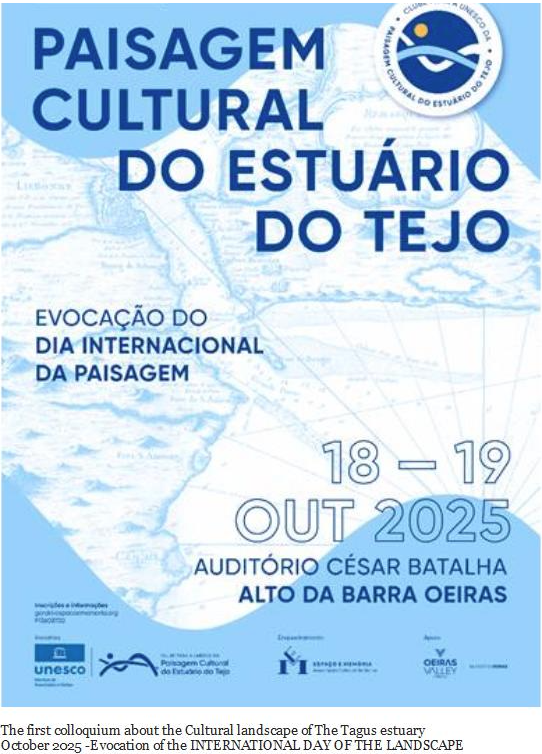
We warmly and enthusiastically announce the establishment of the new UNESCO Club for the Cultural Landscape of the Tagus Estuary.
On February 14, 2025, the UNESCO Club for the Cultural Landscape of the Tagus Estuary was formally established. The signing of the agreement between the EMACO Cultural Association of Oeiras and the directors of the Portuguese Committee for UNESCO took place during a ceremony in the Royal Room of the Palace of the Marquis of Pombal in Oeiras.
The club’s objectives are to promote the principles of UNESCO - peace through education, science, culture, and communication - with a focus on the Tagus Estuary, its history, and its heritage as a cultural landscape shaped by manor houses, fortification systems, and holy places and pilgrimage sites.
The Tagus Estuary boasts a rich geological and geomorphological history, resulting in a complex and diverse natural landscape. Abundant in natural resources, it has been the heart of human settlements from prehistory to the present. The estuary’s history is deeply connected to Mediterranean civilizations, beginning with the arrival of the Phoenicians, Greeks, and Romans, followed by Celtic and Visigoth communities. For nearly three centuries, it was occupied by Moorish kingdoms from North Africa. Finally, the Kingdom of Portugal was established through the Christian reconquest of this region of the Iberian Peninsula. Lisbon, the capital of Portugal since the 12th century, flourished due to the estuary’s rich resources and its strategic Mediterranean and Atlantic deep-water seaport.
The resulting cultural landscape, shaped by this rich past, endures today. It includes layers of urban history, architecture, and rural and natural landscapes, with sites that remain from the age of discovery - such as the departure points for ships that explored and connected Portugal to new worlds in the Americas, particularly Brazil, as well as the Far East, including China and Japan.
The architecture and urban planning of the Estuary, along with its manor houses, estates, and gardens, continue to shape the metropolitan territory today. These elements are now a source of economic wealth and growth, driven by modern tourist itineraries, enotourism, and the world-famous seven wine regions - all central to the economic and social life of the Lisbon metropolitan area.
My research and academic studies on the Estuary began more than twenty years ago, encompassing events, exhibitions, congresses, debates, and publications.
With the UNESCO Club, we are opening a forum - a space for partnerships and the exchange of knowledge, both nationally and internationally, focused on the cultural landscapes of estuaries. I hope this will also foster future connections with the “Encounter” community.
Rodrigo Dias, Universidade Lusíada de Lisboa
For further information contact: rard16@hotmail.com