
Call for Papers: The Art of Hosting: Creative Labour, Artmaking, and Social Networks
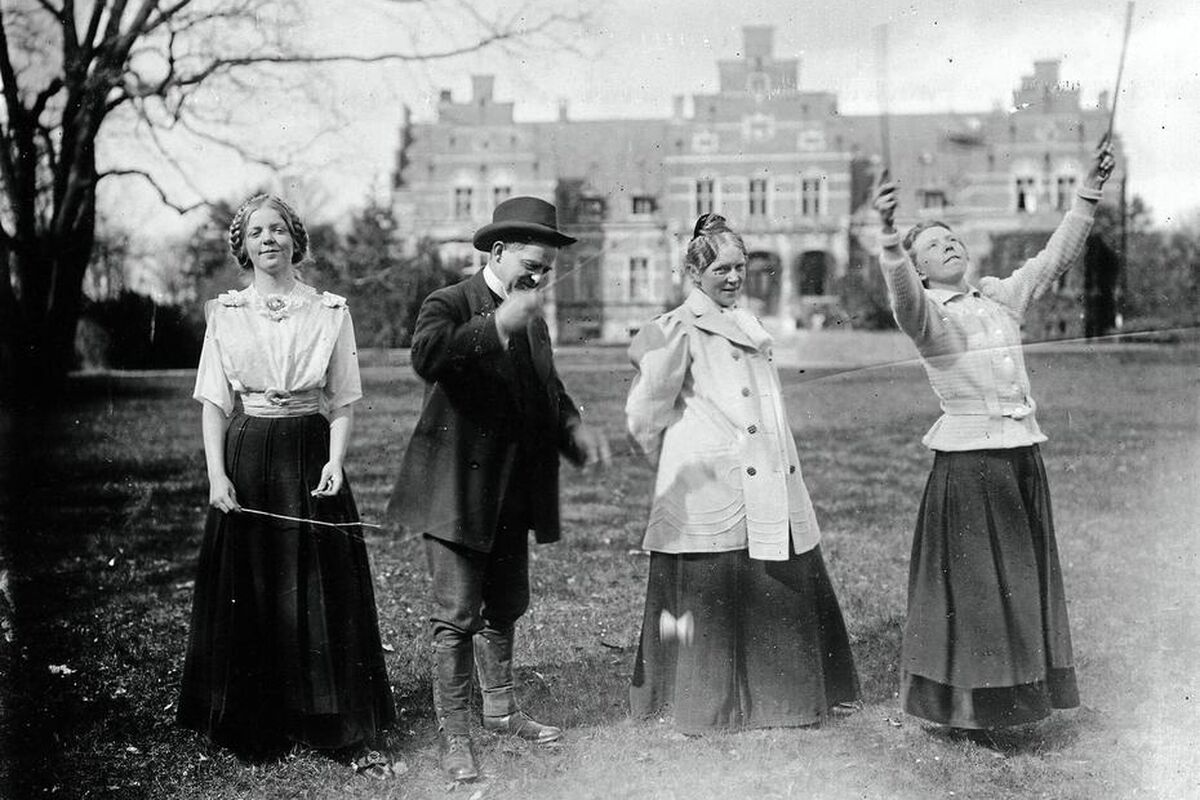
Danish composer Carl Nielsen (1865-1931) and his wife, sculptor Anne Marie Carl-Nielsen (1863-1945) with their two daughters at Fuglsang manor. Their host, lady of the house, Bodil Neergaard (1867-1959) came from a family of musicians. Photo: Wikimedia Commons.
The conference panel entitled "The Art of Hosting: Creative Labour, Artmaking, and Social Networks” seeks to critically interrogate the history, capacity, complexity, and creativity of hosting by and for artists.
Traditionally, artists have first and foremost served the owners of manors and country houses. At times, however, they have also been welcomed as honoured guests—the Danish author Hans Christian Andersen (1805–1875), who visited frequently and often stayed for extended periods, being a notorious example. For researchers of country-house and estate history, it may also be of interest to explore how some artists, particularly in the nineteenth and early twentieth centuries, became owners themselves. Some, such as the Russian author and nobleman Leo Tolstoy (1828–1910), acquired their estates through inheritance; others, such as the Swedish author Selma Lagerlöf, established themselves as country-house owners through purchase and development; while others, such as the Danish painter Sven Schou (1877–1961), became owners through marriage. These artist-owned manors and country houses often became venues for social life, where their owners could cultivate the art of hosting.
Hosting artists and artists hosting
Rarely recognised as labour at all, the art of hosting has not been seriously considered as a specific form of creative labour. Convened to coincide with the exhibition ‘Ethel Sands: Dripping with Light’ at Charleston House, Firle, curated by the convenors, this panel seeks to critically interrogate the history, capacity, complexity, and creativity of hosting by and of artists. Situated in a wider scholarly turn towards relational analysis, this panel will push at the boundaries of existing narratives of network and collaboration in the context of art history.
Ethel Sands was a queer Anglo-American modern artist and hostess. She was a friend of many of the most prominent British artists and creatives of the first half of the twentieth century, including Walter Sickert, Duncan Grant, Vanessa Bell, Virginia Woolf, and Augustus John. But her art has rarely been taken seriously, being overshadowed by her reputation as an heiress and ‘glittering’ hostess. As a case study, Sands’s life and legacy raise critical questions about the perceived conflict between artmaking and hosting, the invisible labour of creating community, the intersections of care and creativity, the feminisation of hosting, and the complexities of class dynamics.
Papers are invited on the intersection of hosting and artmaking across periods and geographies. Themes to consider include, but are not limited to:
• Hosting as creative labour
• Intersections of class and gender
• Gendered understandings of hosting
• Historicisation of hosting
• Critical (re)readings of host(ess)ing
• Conflict between hosting and artmaking
• Hosting as an artist and/or hosting of artists
• Parties, gossip, anecdote, drama
Themes: collaboration, social networks, women’s labour
Additional format comment: Proposed format: 3-4 papers followed by a roundtable discussion chaired by the convenors.
Lead Convenor: Eliza Goodpasture, The Charleston Trust / Ashmolean Museum, University of Oxford, United Kingdom
Co-convenors: Rebecca Birrell, The Charleston Trust / Murray Edwards College, University of Cambridge, United Kingdom
To submit a Paper to this Session, please follow the guidance on our website and complete the AAH 2027 Call for Papers Proposal Submission Form.